
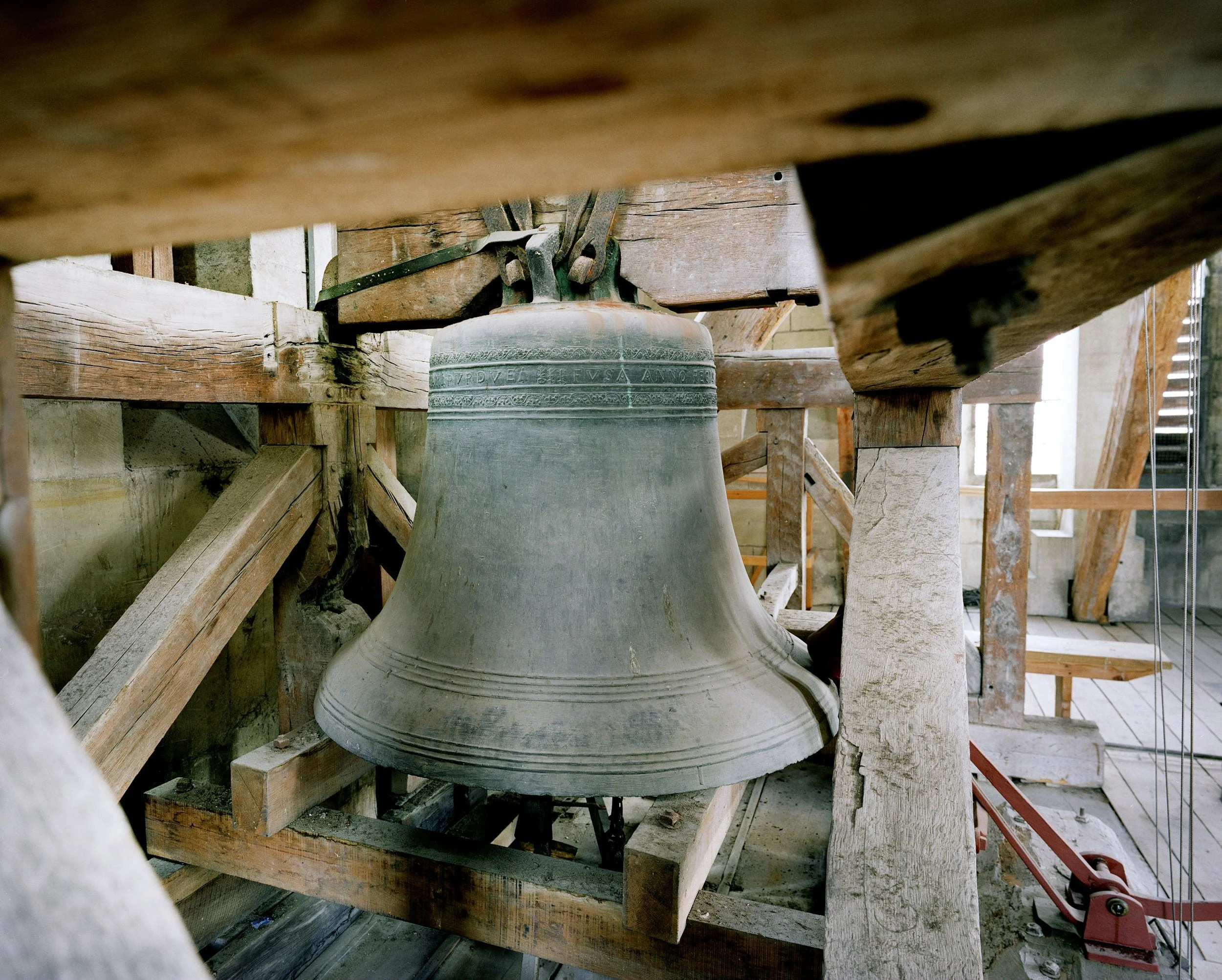
The Bells of St Mary’s
The Bells of St Mary Magdalene, Newark upon Trent
It is probable that there have been bells in St Mary’s Church for as long as it has had a tower. Medieval Canon Law stipulated that, as a general rule, parish churches should have three bells and cathedrals five. However, this wasn’t always strictly enforced and could be circumvented by securing permission from the Bishop or Archbishop to secure a larger number. The earliest known reference to any ringing at St Mary’s occurs in the will of Mary Carlton dated 1468 who bequeathed “For the ringing of the bells for my soul, 21 pence.”
When Edward VI’s Commissioners visited to assess the church’s valuables in 1552, they found five bells. These would not have been harmonically tuned or hung for full circle ringing as is the case nowadays but chimed. Records tell us that between 1626 and 1629 a great deal of work was done, with these bells being rehung (possibly for full circle ringing) and the 4th being recast. Around 1639/40 the 2nd bell of this peal was rehung and 1642 the 5th was recast. At this time two bells were cast for nearby South Scarle by George I Oldfield, a Nottingham bellfounder, and it is probable that this project was combined with that one. Although no definite record survives, at some point between 1646 and 1656 a sixth bell was cast for St Mary’s. These may not have been the most tuneful of bells because in 1658 payments were made for George Oldfield to come over from Nottingham and do some re-tuning. In those days it would have been by hammer and chisel. Then the records tell us that in 1680 the tenor, or heaviest bell of the peal, had to be recast. Records indicate that it was taken by boat to Nottingham for recasting. Churchwardens accounts tell us that in 1682 the ringers were paid ten shillings for ringing on St George’s Day and May Day.
In 1712-13 these bells were completely replaced by a new ring of eight, cast by Abraham Rudhall of Gloucester. It was standard practice at the time for existing bells to be melted down and their metal to be used in the casting of any new bells, so one can be reasonably confident that this was what happened. Most of the cost appears to have been borne by Brigadier General Sir Richard Sutton who donated £200 to the project, a not inconsiderable sum of money at the time. Considering that they would have been hung on plain bearings in a timber frame, these bells gave reasonably good service. Only two major interventions are recorded that we know of. These were the recasting of the 3rd bell by Pack and Chapman of Whitechapel in 1775 and the subsequent recasting of the tenor, which had to be attempted twice, in 1821 by Robert Taylor, then of St Neots. The original tenor bell of this peal weighed 28 Cwt, 1 Qtr. and 7 1bs. Cornelius Brown in his History of Newark on Trent, even adds the extra detail of a further 7 ounces! Its successor of 1821 was slightly heavier, weighing 29 Cwt and 14lbs. Due to the rudimentary nature of the fittings, ringing a tenor anywhere near that weight at the time, was highly labour intensive and required two men.
A report in the Nottingham Journal of 1841, indicated that the tenor of this ring had become useless and the rafters (frame) was in a decayed state. In 1842 a new peal of ten bells was cast by John Taylor & Co, a company which had recently moved from premises in St Neots and Oxford, to Loughborough. They did it by melting down the old eight bells and adding extra metal. A new frame was provided at the same time. According to the Leicester Mercury, the bells were brought by boat up the Trent, first to top Roving, where they were greeted by the ringing of handbells, and then to Huddlestone Top Wharf in Millgate, where crowds gathered to see the new bells. Unfortunately, the person entrusted with hanging the bells can’t have been very experienced as they soon became difficult to ring and within 18 months were rehung by another contractor called Mr Smith. In 1846 the treble was re-tuned and the second completely recast. For over half a century no major work appears to have been done on the bells, but in 1897 they were rehung by Taylors with new fittings. It probably wouldn’t happen nowadays, but at the same time the canons were cut off the tops of the bells, and they were attached to the headstocks using crown staples. Along with installation of the present clock by Joyce of Whitchurch (1898) the work was designed to mark the Diamond Jubilee of Queen Victoria’s reign.
In 1913 cracks were discovered in the tower and it was found to be leaning alarmingly to the south. Consequently, to allow restoration to happen the bells were temporarily removed from the tower so that steel bars could be inserted into the walls to strengthen it. During 1914-15 the bells were rehung in a new low sided cast iron frame supplied by Mears and Stainbank of Whitechapel. This cost £2300 raised by public subscription and a reinforced concrete floor was installed around the same time.
An ‘Ellacombe’ chiming apparatus was provided under the will of Dr Walker, Vicar from 1919 to 1929. It was operated at ground level from a cupboard by the West Door. This chiming apparatus still exists but probably hasn’t been used since around 1960. It could be brought back into use, but some work and investment would be needed to bring it back into a usable condition. Also, in 1933 a Sanctus bell was provided, again under the will of Dr Walker, and this hangs in the ancient bellcote above the transept crossing, which had long been empty, probably since the Reformation. This Sanctus bell, in the key of A natural, is very small, weighing 1 Cwt 2 Qtrs. and 26lbs. It is meant to be chimed at the Consecration during the Holy Communion service but is also used to announce some early morning and midweek services.
In 1954 the tower bells were rehung by John Taylor & Co of Loughborough on ball bearings provided by Ransome and Marles. This was made possible on account of a bequest of £1000 from Mr Charles Henry Newbald who re-founded the Society of Ringers in 1896 following a difficult chapter in the tower’s history. Since the 1954 rehang, it has been possible for the tenor bell to be rung by one person when it is in the ‘up’ position. However, raising it is still a two-person job. Although the work carried out in 1954 greatly improved the “go” of the bells, it was insufficient to address the significant oscillation in the tower, when all ten bells are rung. This is caused by the forces created by the ninth and tenor bell hanging on the same side of the frame and swinging in the same direction when they’re rung. A certain amount of oscillation within a tower is normal though and this should be borne in mind. As a matter of interest, the current tenor current tenor bell weights 31 Cwt 1 Qtr. 11 Lbs. It is in the key of C# and is exactly 1 Cwt lighter than the tenor of St Wulfram’s Grantham.
Two special traditions are associated with Newark’s bells. One is ringing of the Pancake Bell at 11am on Shrove Tuesday. In medieval times a “Shriving Bell” was rung on Shrove Tuesday, inviting the faithful to come to confession before Lent. This lapsed at the Reformation, but it was revived in 1950 as the Pancake Bell – a reminder to people to get the batter ready for their pancakes. At the time of writing, this has been done every year since with only one exception – 1951. Another is “Ringing for Gopher”. Gopher was supposedly a Flemish merchant who lived at an indeterminate time sometime between the 13th and 18th centuries, who was guided to safety by the sound of Newark’s bells when he got lost in the fog near Averham. Legend has it that he left a bequest for the bells to be rung annually in thanksgiving for his guidance to safety by their sound. If a bequest ever existed, it has long since been exhausted. However, from at least the middle of the 19th Century until a few years ago, a custom obtained of “Ringing for Gopher”. This took the form of a period of extended ringing of one hour’s duration before Evensong, starting on the 12th Sunday before Christmas and running for six weeks. It is much to be hoped that in due course this venerable custom might be revived.
With grateful acknowledgement to George A Dawson’s “The church bells of Nottinghamshire” (1995) and Brenda M Pask’s “Newark Parish Church of St Mary Magdalene (2000) without which this would not have been possible.
Adrian F Sunman
Deputy Master, Newark Parish Church Society of Ringers (2016 – 2026)